A startup can lose qualified demand long before a sales call happens. A slow landing page, a checkout that feels unreliable, or a CMS your team cannot update turns paid traffic into wasted budget. The best startup website tech stacks are not the ones with the longest list of tools. They are the systems that help you launch quickly, earn trust, convert cold traffic, and scale without rebuilding your digital foundation six months later.
For founders, the decision is commercial before it is technical. Your website needs to match your business model, growth stage, internal capability, and the job it must perform: generate leads, validate a product, sell online, support a platform, or build investor-ready credibility.
Start with the outcome, not the framework. A pre-launch SaaS company needs a sharp, high-converting marketing site and a reliable waitlist flow. A funded software business may need an authenticated product experience, integrations, analytics, and content infrastructure. An ecommerce operator needs catalog control, fast checkout, inventory connections, and campaign landing pages that can move with marketing.
The wrong stack creates friction in places that matter. A fully custom build can be excessive for a company still testing its offer. A template-only website can limit a brand that needs distinctive positioning and complex conversion paths. The right answer depends on what needs to be flexible, what needs to be fast, and what must be controlled by your team after launch.
Assess each option against five practical questions: Can it support your growth target for the next 12 to 24 months? Can your team publish pages and campaigns without developer delays? Does it protect speed, accessibility, and search performance? Will integrations with CRM, payments, analytics, and email tools remain manageable? And does it present the level of polish your customers, partners, and investors expect?
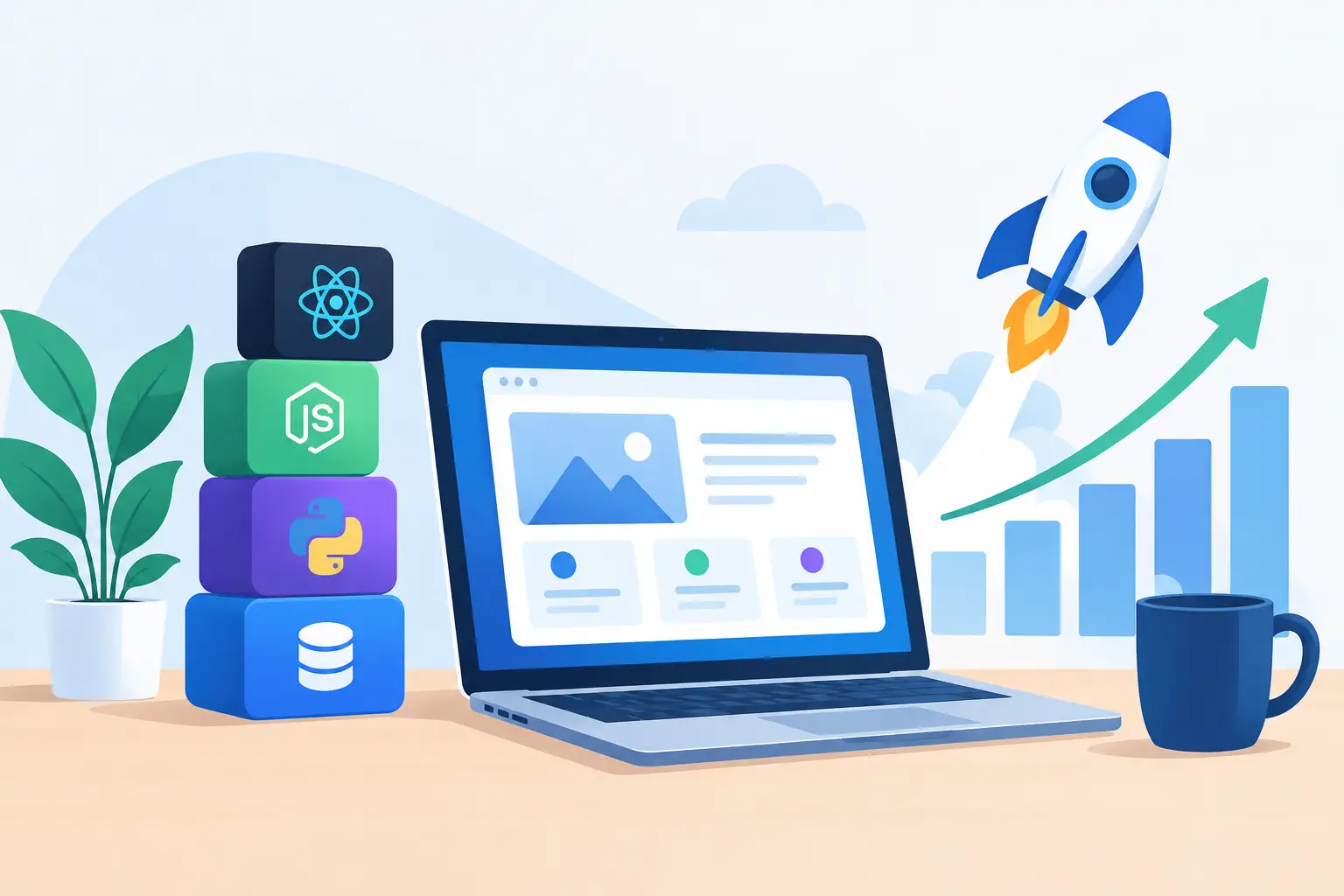
For ambitious SaaS, fintech, marketplace, and AI startups, a modern JavaScript stack built around Next.js is often the strongest long-term choice. Pair it with a headless CMS such as Contentful, Sanity, or Strapi, then deploy through a cloud platform such as Vercel, AWS, or another managed environment suited to your engineering needs.
This setup gives you high performance, flexible design control, and the ability to separate the website from the content system. Your marketing team can publish case studies, feature pages, and resources while developers retain control over components, data, security, and product integrations. It is especially valuable when the public website and logged-in product need to feel like one connected brand experience.
The trade-off is complexity. A headless architecture needs experienced planning, clean content modeling, and ongoing technical ownership. It is not the best choice when speed to launch matters more than custom functionality or when no one can maintain the stack after handoff.
Choose this stack when your site is a serious growth asset, not a digital brochure. It is built for companies that expect frequent experimentation, international expansion, product-led growth, and evolving requirements.
Webflow is a powerful choice for early-stage and growth-stage businesses that need premium design, strong marketing agility, and a fast route to launch. It works particularly well for B2B startups, consulting firms, agencies, service platforms, and companies building authority before or alongside a larger product launch.
Its biggest advantage is control. A well-structured Webflow site lets marketing teams update copy, create campaign pages, publish content, and refine conversion flows without turning every change into a development ticket. That speed matters when you are testing positioning, responding to sales feedback, or running paid acquisition campaigns.
Webflow can also produce a polished visual experience that looks far beyond a typical template website. For startups competing in crowded categories, that difference influences trust. Buyers make rapid judgments about whether a new company looks credible, capable, and ready for enterprise conversations.
Its limits appear when your requirements become application-heavy. Complex user accounts, advanced commerce logic, highly customized databases, and proprietary dashboards may require custom development or a separate product stack. Use Webflow for what it does best: a conversion-focused marketing engine that your team can actively operate.
WordPress remains a practical option when publishing volume, editorial workflows, and search-led customer acquisition are central to your strategy. For startups building a resource center, publishing market insights, supporting multiple authors, or managing large libraries of landing pages, WordPress offers mature content capabilities and broad flexibility.
The platform can be highly effective when it is designed and engineered properly. A custom theme or carefully selected block-based architecture can create a fast, branded site without locking the business into a generic appearance. It also connects easily with the tools many sales and marketing teams already use.
However, WordPress requires discipline. Too many plugins, poorly maintained themes, and ungoverned access can create speed and security problems. Founders should not choose it simply because it is familiar. Choose it because content is a meaningful acquisition channel and you have a clear plan for maintenance, updates, and performance optimization.
For businesses where authority is earned through useful content over time, WordPress can be one of the best startup website tech stacks. For a design-first launch site with limited content needs, it may be more infrastructure than you need.
If revenue depends on selling physical products, digital goods, subscriptions, or curated collections, Shopify should be near the top of the shortlist. It is designed around the operational realities of ecommerce: product management, payments, checkout, discounting, shipping, order handling, and marketing integrations.
The critical choice is not whether Shopify can process transactions. It can. The real decision is whether your storefront is built to express the brand and improve conversion. A generic theme may get a store online quickly, but it rarely gives a challenger brand the differentiation needed to win repeat attention or justify premium pricing.
A custom Shopify storefront combines commerce reliability with an experience shaped around your customer journey. That can mean clearer collection navigation, stronger product storytelling, mobile-first merchandising, subscription logic, localized content, and landing pages built for advertising campaigns.
Shopify is less suitable for companies whose core offer is a complex software product or a service business with no transactional storefront. But for ecommerce founders, it removes operational distraction and lets the team focus on brand, acquisition, retention, and average order value.
Your technology stack is not complete when the site goes live. Every startup website needs a measurement layer that tells you what is producing business results. Analytics, conversion events, form tracking, CRM integration, session behavior data, and consent management should be planned before design is finalized, not patched in after campaigns begin.
The same applies to UX and brand systems. A technically capable website will still underperform if users cannot understand the offer, find the next step, or trust the company. Clear messaging, page hierarchy, page speed, responsive behavior, and persuasive calls to action work together. Technology supports conversion, but it does not replace strategy.
This is where a connected build process matters. At Afkar Alkhaleej, startup website decisions are approached as part of a larger growth system: positioning, visual identity, user experience, development, testing, launch, and ongoing campaign performance. That keeps the stack aligned with the business you are building, not just the site you are publishing.
Founders often overbuild because they want to look ready for scale. Others underbuild because they want to launch at the lowest possible cost. Both mistakes can be expensive. The smarter move is to build a clear, credible platform that handles your next stage of growth while leaving room for deliberate expansion.
If you need to validate demand, prioritize speed, messaging flexibility, and measurement. If you are scaling paid acquisition, prioritize landing-page velocity, performance, and CRM connections. If you are selling products, prioritize checkout confidence and operational control. If your product itself is the business, invest in a stack that can support customer experience beyond the marketing site.
Choose technology that gives your team momentum. The right stack should make it easier to launch campaigns, learn from users, improve conversion, and show the market that your startup is built to compete.